Showing posts with label Sweet Vermouth. Show all posts

Sunday, March 23, 2014

Aged Negronis

One cocktail trend I've noticed is the act of aging cocktails in some sort of barrel. I first saw barrel-aged negronis on a menu when I was in Portland last fall. I was pretty intrigued by this--what gets aged in the barrel? Is the cocktail mixed and the whole thing aged or was just one ingredient aged (and if so, which one)? What sort of barrel was it aged in? Once I got home, I did some research and found a good entry on the barrel-aged cocktail trend on Jeffrey Morgenthaler's blog. I like the idea of pre-mixing drinks; it certainly makes dishing up drinks at cocktail parties much faster. I love a drink experiment, so I thought about what I wanted to make and how I was going to age it.

I thought about what would benefit from being soaked in a bourbon barrel (or equivalent) for a few weeks, and I pretty much immediately wrote off bourbon-based cocktails. The bourbon's already been aged for years in bourbon barrels, what's the point of aging it a few more weeks? I can see aging a specific ingredient like Campari or sweet vermouth and then mixing it with bourbon, but that's a test for another day. Because my two main spirit bases are bourbon and gin, I decided to focus on a gin drink. Since Morgenthaler did negronis, I figured I start with that, too. Essentially, you can age anything that's all booze, but I wanted to start simple and focus on a drink that I'm already very familiar with.

Now, I had to decide what I was going to age it in. There are multiple places online to get mini barrels, but that seemed like a lot of booze when I had no idea if this was going to be drinkable or not. One of the places that sells mini barrels, Tuthilltown Spirits, also sells kits that have a 375ml glass bottle along with a wood stick from a barrel. These sticks use something Tuthilltown calls "honey comb" cutouts; the sticks have many little holes drilled at all angles to provide for more surface area. The price on one of these kits is low ($12.50) and it requires a lot less booze, so I went with this.

At some point in my research I came across this blog entry from ManMade. This guy was doing exactly what I wanted to, so I used this as a model. I ordered a bag of Jack Daniel's Wood Smoking Chips from Amazon as an alternative to the barrel staves from Tuthilltown (I used 12 grams of chips so it would be nearly the same weight as the stave) and went to work mixing my batches of negronis.

The recipe I used was a basic negroni mix, but because I was making two batches that were 375ml, I upped the size of my batch. Each bottle had:

  • 1/2 cup Plymouth gin
  • 1/2 cup Campari
  • 1/2 cup Carpano Antica sweet vermouth

The picture on the left is the barrel stave kit from Tuthilltown; the right is a mason jar with Jack Daniel's wood chips.

Pre-aging

I put these both in the root cellar (a dark, cool place) for two weeks. I shook them up every three or four days. After two weeks, I opened them up, strained each into its own pitcher, and invited folks over for taste tests. I also made a pitcher of "fresh" negronis as a base line. Right away I could see that the aged batches were much darker in color than the fresh. I thought that might tip everyone off to which was the fresh, but it didn't. I labeled each pitcher A, B, or C so it was a blind taste test. To really nerd out, I made up a questionnaire to capture what people thought as they tasted each sample. If I was going to do this again, I'd probably give everyone all three samples at once so they compare each against each other.

Some photos:

 
 Pouring Sample A

Filling out the questionnaire for Sample A

Pouring Sample B

The samples have been consumed...now to score these!

Sample A was the wood chip version, B was the fresh, and C was the barrel stave version. I added an small orange peel garnish to each. Most people thought the wood chip version was the most bitter and they generally liked the barrel stave version the most. Personally, I thought A was pretty smooth, not overly smoky, and quite sweet. No one else really agreed with this opinion, but maybe I was biased because I was hoping the best would be the one with the cheapest barrel ingredient. Anyway, the two smoked versions were really very different from the fresh and from each other. I would definitely make either version again as they were both quite tasty.

I plan on aging other cocktails in the future--so far I've thought about the Bijou (gin, sweet vermouth, green Chartreuse, and orange bitters), the Martinez (Old Tom gin, sweet vermouth, maraschino, and bitters), and the Dubonnet Cocktail (gin and Dubonnet). Dear readers, have any of you jumped on this trend? Post in the comments what you've aged and how you've aged it.

Monday, December 2, 2013

The Bronx Cocktail and the Income Tax Cocktail

I recently bought a set of four Thin Man movies. For those of you who aren't familiar with the film series, just know that the first one was released in 1934, is based around a detective (Nick Charles) and his wife (Nora), and includes a LOT of references to drinking. I highly recommend it--it's an excellent cocktail movie. Anyway, at one point, Nick Charles is at a bar, talking to some bartenders while he orders a Martini. He instructs the barkeeps, "The important thing is the rhythm. Always have rhythm in your shaking. Now, a Manhattan you shake to fox-trot time, a Bronx to two-step time, a dry martini you always shake to waltz time." I'd heard of a Bronx cocktail before (I love a Manhattan), so I decided to mix up a few of these. 

There are a couple of theories about who came up with the Bronx. Some people think Joseph Sormani created it in Philadelphia around 1905. Other sources credit Johnnie Solon (a bartender in Manhattan), sometime around 1899-1906. Check out the Wikipedia page about this cocktail out; the Solon theory has an entertaining creation story.

I generally don't trust the cocktail recipes on Wikipedia, so I hit the cocktail books and found this in Vintage Spirits and Forgotten Cocktails. It was filed under a different drink, the Income Tax. One of my favorite things about cocktails is the history of the cocktail or how cocktails relate to each other. For example, the Manhattan (sweet vermouth and bourbon) became the Martinez (sweet vermouth and gin) became the Martini (dry vermouth and gin)...I just find this incredibly interesting (this is an excellent story about just this genealogy). From the standpoint of a very amateur barman, these connections make it easier to add drinks to my "memorized cocktail" list, just by slight adjustments. The Income Tax is just a Bronx, but with two dashes of Angostura bitters. 

The Bronx
  • 1 1/2 oz gin (I used Gordon's)
  • 3/4 oz sweet vermouth
  • 3/4 oz dry vermouth
  • Juice of 1/4 orange, freshly squeezed (This is obviously really vague. I used 1/3 of an oz.)

The Income Tax
  • 1 1/2 oz gin 
  • 3/4 oz sweet vermouth
  • 3/4 oz dry vermouth
  • Juice of 1/4 orange, freshly squeezed
  • 2 dashes Angostura bitters

I quite liked both of these drinks. I would call the Bronx a citrus-y cousin to the Manhattan--the orange mellows the booze a little, but it is still pretty strong. As for the Income Tax, the bitters add a little sophistication and a lot of depth to the drink. These are ingredients that are pretty common, so you probably already have everything to make them, so that's a nice bonus that rarely happens. 


Wednesday, November 6, 2013

Blood and Sand

Recently, I was at a local bar, and the bartender and I were discussing mixed drinks made with Scotch. I'm a total Scotch novice, especially cocktails with Scotch, and she recommended a Blood and Sand. I had never heard of this, but since then I've noticed it in multiple cocktail books, including The Savoy Cocktail Book, which I just got today. I wanted to try something from the book, so I went with this drink.

A little history: this cocktail is named after a Rudolph Valentino movie from 1922, Blood and Sand. Valentino plays a bullfighter (hence the blood). The Wall Street Journal did a write-up of this drink and its history in 2008; check out that article here.

Just a word of advice--you should probably check to make sure you have all the necessary ingredients before you start dumping stuff in a glass. I could have sworn I had a bottle of Scotch, but nope, no such luck, so I made this one with bourbon. Oops.

The real ingredients for the Blood and Sand are:
  • 1 part orange juice
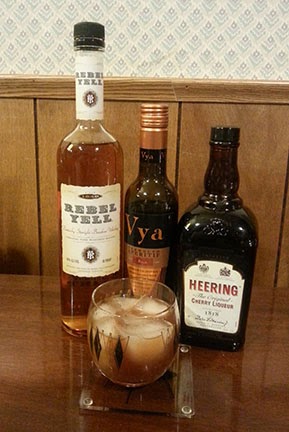
  • 1 part Scotch whisky (whiskey vs whisky; I used Rebel Yell Bourbon)
  • 1 part Italian vermouth (red/sweet vermouth--I used Vya)
  • 1 part cherry brandy (I used Cherry Heering)
Mix all ingredients in an ice-filled shaker and strain into a cocktail glass. Garnish with a cocktail cherry.

Now, I have no clue what this would taste like with Scotch, but I am pretty pleased with how this turned out with the bourbon. Surprisingly, it's not very sweet. Actually, it doesn't even have much of an overwhelming flavor of anything. I like it, but the next time I make this I'm going to have to get some Scotch so I know what it really tastes like. 


Negroni and Americano

Lots of people go for years seeing the bottle of bright red Campari on a shelf behind the bar, or at the liquor store, and wonder what in the world you do with it. Some of those people discover Campari by way of one of the most classic of cocktails, the Negroni. It's a 1:1:1 cocktail, like the Sidecar, but its flavor profile is completely in the opposite direction of that other classic.

1 oz gin
1 oz Campari
1 oz sweet vermouth

Stir in a mixing glass and strain into a short glass with fresh ice. Garnish with a wide swath of orange peel, which you should squeeze over the glass before dropping it in.

You may notice that the drink in my photo --it's the one on the left -- is missing the orange peel. Sometimes you realize you really want a Negroni, even if you don't have any oranges in the house. Brad Thomas Parsons, in his excellent book Bitters suggests a few dashes of orange bitters to bring out the flavor, so I thought that might be good, in the absence of the peel. The peel is fantastic, don't get me wrong. But it's a shame to forgo a Negroni for want of orange peel.

I used Aviation gin, because it's an American-style gin, which means it's slightly less juniper-heavy, so I thought it would play nice with the bitters. I also used Punt e Mes, which is probably one of my favorite things in the whole Booziverse. "Punt e Mes" means "point and a half", which refers to the fact that Italians traditionally like to put bitters in their vermouth, and Punt e Mes is Italian (sweet) vermouth with bitters already added. It's delightful with soda and a slice of lemon. You may certainly use whatever sweet vermouth you like. Punt e Mes with Campari might be just too much bitters for some, but we love bitters in this house.

On the right side of the photo above, you'll see the Negroni's cousin, the Americano.

1.25 oz Campari
1.25 oz sweet vermouth
soda water
twist of lemon peel

It's like a Negroni with soda and no gin. You might wonder in what circumstance you would want "no gin", but sometimes that's what hits the spot.

A note about the soda water: I have seen the Americano made as a highball, with more soda. I read in How to Drink by Victoria Moore that less soda is better with bitters than more soda. She claims that you might think you can soften the bitter taste of Campari by diluting it with more soda, but what actually happens is you dilute the sweetness, which only sharpens the bitterness and throws off the balance. I have tested this myself, and it's true. So when I make an Americano, I stick with the short glass, and add just a bit of soda.

Monday, October 28, 2013

The Boulevardier

Tonight's cocktail is the Boulevardier, close cousin to the Negroni. This is a classic recipe, but the particulars of this one come to you from Vintage Spirits and Forgotten Cocktails by Ted Haigh, AKA Dr. Cocktail (this book is AWESOME, by the way and I highly recommend it). According to the good doctor's research, the Boulevardier first appeared in print 1927, in Harry McElhone's (ex-barman at the Plaza Hotel and owner of Harry's New York Bar) Barflies and Cocktails.

For this one, you'll need:

  • 1 1/2 oz bourbon (I've used Evan Williams, which is probably one of my favorite mixing and plain old drinking bourbons, but you could use anything)
  • 1 oz Campari
  • 1 oz Carpano Antica sweet vermouth (again, the Carpano is suggested, but any sweet vermouth will do in a pinch)
  • Garnish: Cherry (we have some really fancy Luxardo cherries that I like to use), lemon peel, or orange slice
  • Ice
Throw the bourbon, Campari, and vermouth in an ice-filled shaker. Shake until chilled and strain into a cocktail glass. Put the garnish in and enjoy.

This is basically a Negroni with bourbon instead of gin, and honestly I prefer this to the Negroni. I feel like the bourbon sweetens up the Campari, whereas the gin keeps it fairly bitter. I like both drinks though, so make sure you try 'em both and see which you prefer.


I feel like I have to come clean about the shaker business here--I rarely (and I mean rarely) use a shaker. I really only ever use one if someone is having a Martini (which I never do, but occasionally my sweetheart likes a Gibson) or if we have company and I want to be classy. I usually just put everything in an old-fashioned glass, fill it with ice, and stir until it is chilled. I will admit there is something nice about using a shaker, mainly that your drink gets COLD fast, but I tend to struggle with not making a mess. So, if you don't use a shaker, don't feel bad, because I'm right there with you.

Sunday, October 27, 2013

Chet Helms

The latest issue of Imbibe Magazine had a pretty big section devoted to pisco. I'd never had it, and the only drink I'd ever heard of using it is the Pisco Sour. The egg in a PS makes me kind of nervous (I'm still new to eggy cocktails) so I looked for another recipe using pisco and found the Chet Helms on the Imbibe website. I always feel really good about myself when I have all the ingredients for one of these cocktails.

  • 1 1/2 oz pisco
  • 1/2 oz Carpano Antica sweet vermouth
  • 1/2 oz Campari
  • 1/2 oz fresh lemon juice
  • 3 dashes rhubarb bitters (I like Fee's)
  • Club soda
  • Ice
Put the pisco, vermouth, Campari, lemon juice, and bitters in a shaker filled with ice. Shake it up and strain into an ice-fille collins glass. Fill it the rest of the way with club soda and garnish with an orange wedge and mint. 

This has become a house favorite. It's boozy, but not overwhelmingly so and it is quite refreshing. I highly recommend this one.